The rule, event and retained trace remain distinct in a single silhouette. It connects the wordmark to the diagram grammar without claiming verification or approval. Use the full mark from 24px; at 16px remove the inner detail. Recognition and trademark clearance remain untested.
02 / Supporting vocabulary
Notation, not badges.
Evidence
A bounded source fragment; name its provenance.
Authority
A crossbar: name the actor and scope.
Review
Two readings held against one object.
Intervention
A stop at an explicit boundary; effect needs evidence.
Challenge
Opposed accounts kept distinct.
Correction
Retain the prior line beside the amendment.
Uncertainty
Open proposition; identify what remains unknown.
Record
A versioned account, not proof of truth.
Status
A labelled state; never use color alone.
Version
A sequence with explicit dates or release IDs.
Unresolved
An open relation. Missing evidence is not failure.
03 / Diagram grammar
Follow a claim to its effect.
A horizontal line carries ordered events, not elapsed time unless a time scale is supplied. Source fragments sit above it; actor and authority sit below the intervention crossbar. Each relation needs a source. A gap stays visible when the record cannot establish the connection.
SignalRejection proposedEvidence predates an amendment
Interpretation + authorityReviewer records a holdReason and authorization retained
System responseQueue accepts holdOne response is documented
UnresolvedWas the notice stopped?Delivery record unavailable
Hypothetical only. A later correction forms a dated return line to the affected record. Remedy requires its own evidence; it never appears as an automatic completed endpoint.
Interaction / Drawing rules
A map of research questions.
The homepage map places eight research topics in a central ring, with source-linked governance topics, risk records and selected incident cases in five labeled editorial territories. Research topics are filled circles, governance topics diamonds, risk records triangles and incident cases rings. Shape and tone identify record type, not severity. Select a marker to read its question, status and limitations. Drag to move, zoom to inspect, or expand the map. Search, record lists and the card’s trace lists provide other ways to explore. Reduced-motion preferences remove map transitions. Explore the homepage map ↗
Every marker represents a record. Positions are authored for navigation, not learned embeddings. Overview ribbons summarize direct research–governance links by theme. The expanded trace groups records by type and distinguishes reviewed direct links from an outward continuation through intermediate records. An onward record is not a reviewed direct link to the selected record. Position, distance and density do not measure similarity, importance or strength of evidence.
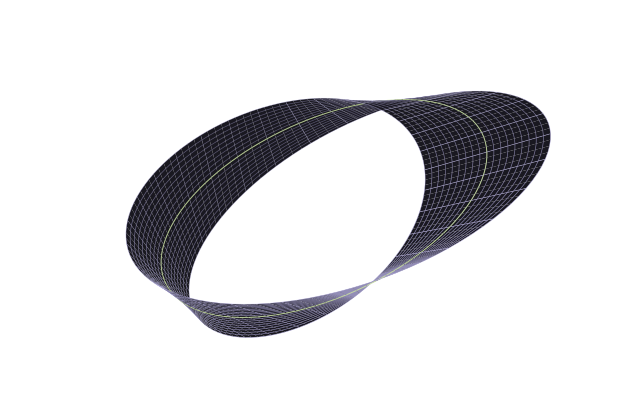
The earlier homepage artwork is preserved below as a visual record. A single ribbon turns through space. Its half-twist connects the surface into a continuous form, while a citron thread gives the eye a path through the changing view. For node&norm, it expresses continuing responsibility: examining decisions, acting on concerns and establishing what happened.
Explore the earlier ribbon artwork and its mathematics
Earlier homepage artwork
Human control is a continuing responsibility: to examine decisions, act on concerns and establish what happened.
Mathematical artwork · A 32-second cycle.How the motion is constructed
The surface. The ribbon makes one half-turn before its ends join. This gives it one continuous side and one boundary. Its width is controlled by v, while u travels around the ribbon.
S(u,v) = ((148 + v cos(u/2)) cos u, (148 + v cos(u/2)) sin u, v sin(u/2)) 0 ≤ u ≤ 2π; −54 ≤ v ≤ 54.
The rhythm. Two rotations vary smoothly over a 32-second cycle; a third rotation stays fixed. They are applied around the X, Y and Z axes, in that order. All angles below are in radians.
φ = 2πt/32 pitch = 0.86 + 0.18 sin φ yaw = −0.35 + 0.22 cos φ roll = −0.28.
The view. A shallow perspective projection gives the ribbon depth. For a rotated point (x, y, z), and a drawing area W pixels wide and H pixels high:
f = 1200/(1200 − z); s = min(W/480, H/340) screen = (W/2 + sfx, H/2 + sfy).
The line work. The renderer divides the ribbon into 112 strips, samples 19 positions across its width, and draws 28 straight cross-lines. A citron thread follows the center at v = 0. The strips are drawn in order of average depth, with line brightness varying by depth. This is an artistic rendering method, not a physically exact visibility calculation.
Pause the motion or move the slider to inspect the form. Play motion resumes from that point. Reduced-motion preferences start the drawing still at six seconds. The animation pauses when offscreen or when the browser tab is hidden. A static SVG remains available when animation cannot run.
These equations are drawing rules, separate from the research methods. The artwork does not measure human influence, establish that a control worked, or represent an experimental result.
A focused introduction and an interactive research topic map at left. Six readings at right. Hover or keyboard focus highlights the whole reading card in light iris.
The research questions, methods and researcher background follow one narrative, with a contents guide at right. Links lead to the current research agenda and the governance explorer.
Space Grotesk gives the wordmark, headings and current editorial pages their structure. Iris belongs on carbon; darker iris (#5145CD) carries links on paper. Citron identifies the conceptual intervention bar, never a success state.
Keep the main visual tied to a reading task. Label notation in ordinary language, distinguish illustration from evidence, and provide visible focus and text alternatives. Prefer deliberate interaction over automatic movement. The homepage map responds to readers; the earlier ribbon demonstration retains its pause control and reduced-motion support.
The earlier Möbius surface uses a mathematical parameterization, periodic rotations and a perspective projection. Its construction, static SVG and source files remain available in the archived asset kit. The current interactive map is implemented separately on the homepage. Neither artwork measures human influence or establishes research findings.

 01